Zurich, Munich and the Stuttgart region are only a few hours apart, but their robotics and physical AI teams are built from quite different talent. My bet is the hiring leaders who search across the three will reach people their rivals miss.
Physical AI teams in Zurich, Munich and around Stuttgart keep telling me they've run out of people to hire in town. Maybe they have. But the people they need are often a train ride away, in a city with a different mix of talent.
In Fuze's own data there are around 2,500 people at physical AI and robotics companies across the three cities. Going by their job titles and where their employers are based, each city leans towards different skills, and very few people work for a team in one of the other two.
My take: the teams that hire best here will treat Zurich, Munich and the Stuttgart region as one hiring map, not three.
Zurich is the research-heavy corner
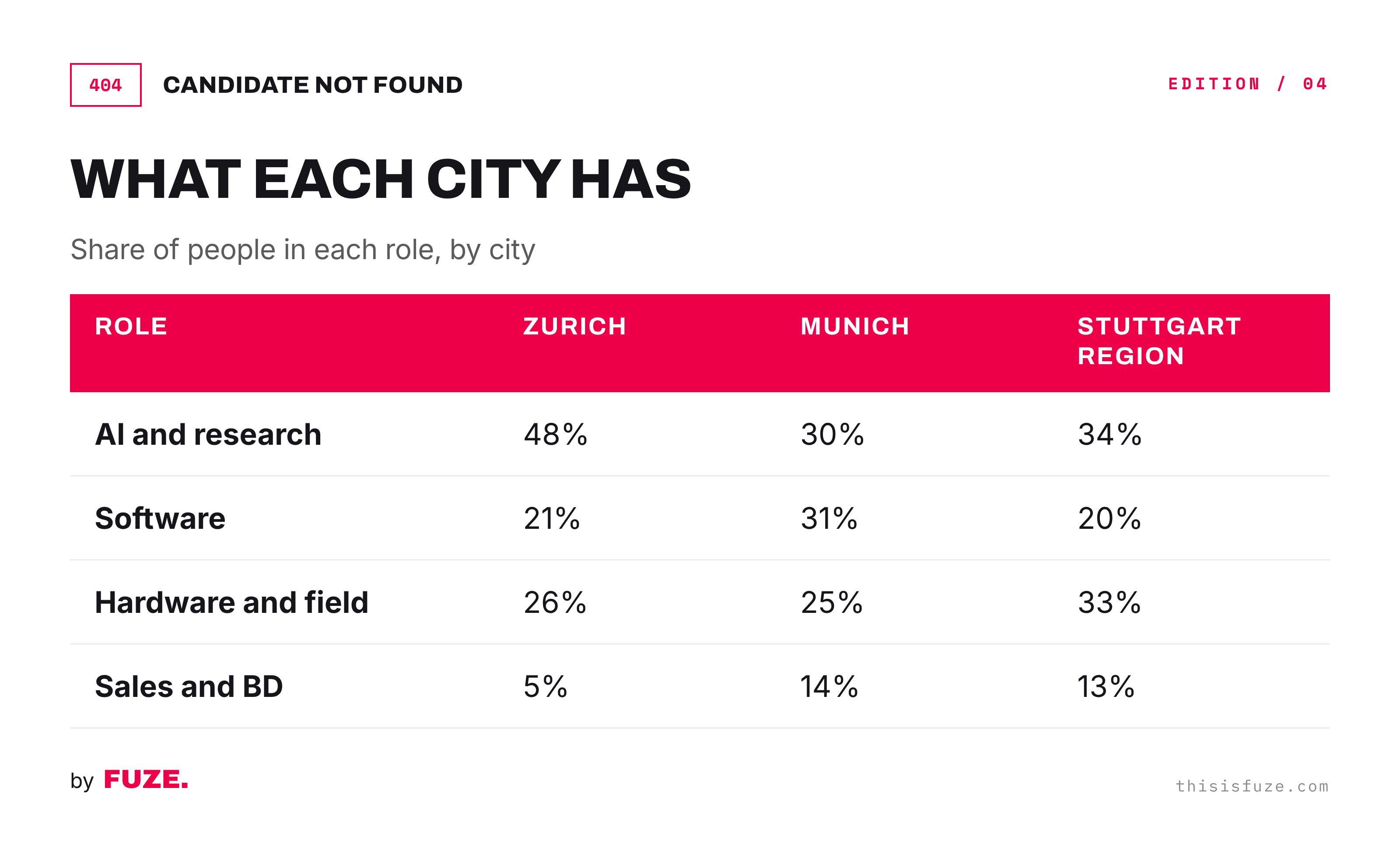
Going by job titles, close to half of the people in Zurich teams work in AI, research or controls. In Munich and the Stuttgart region it's about a third or less.
With ETH Zurich on the doorstep, that's not a huge shock. Among the better-known employers in our data there are Hexagon Robotics, Gravis Robotics and the RAI Institute.
What this means for your hiring strategy: Zurich has the highest share of research people of the three, and the lowest share of sales people.
My read: My read: I think the gap in Zurich is commercial. Plenty of great engineers, very few people to take the product to customers.
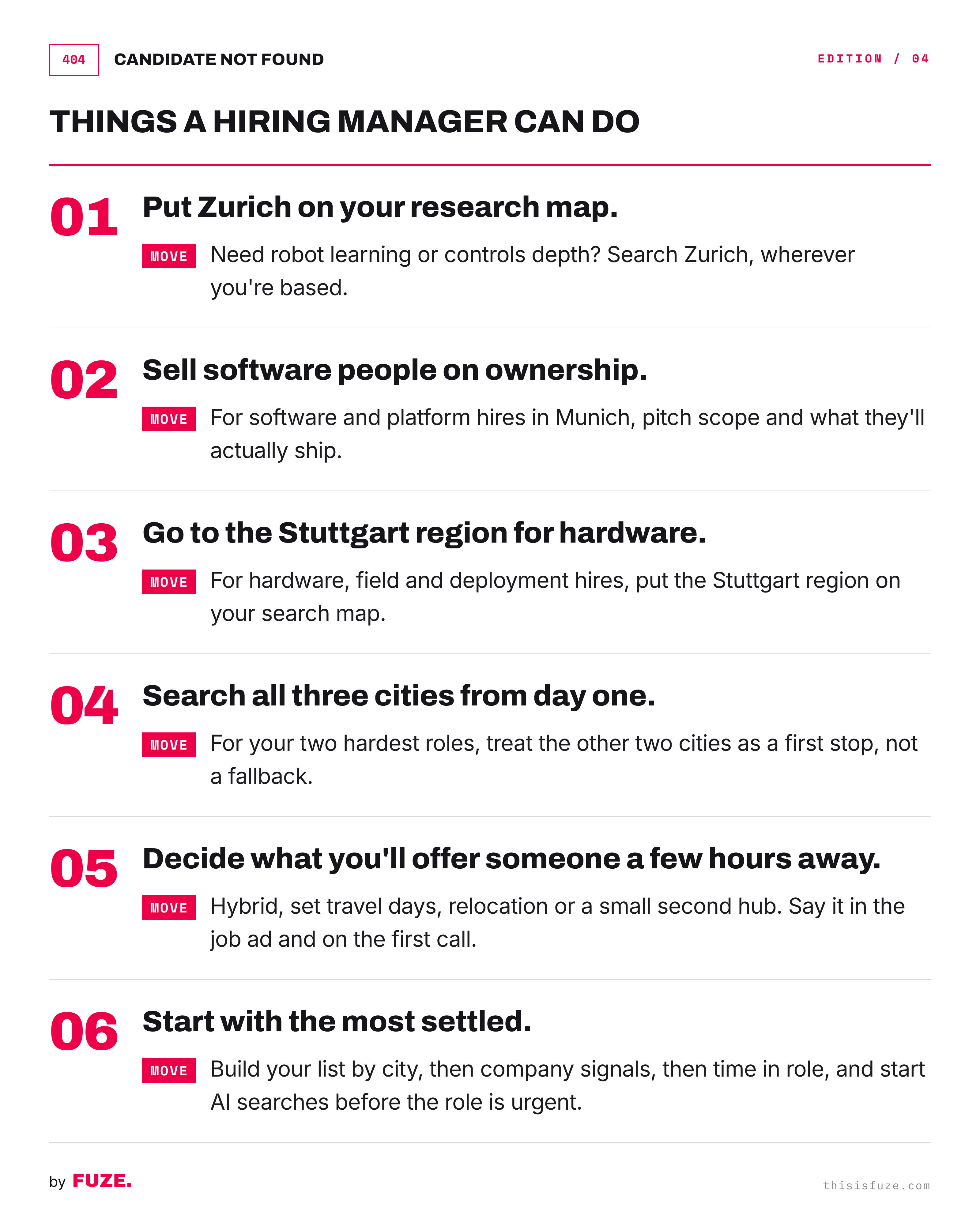
What to do: Need robot learning or controls depth? Put Zurich on your search map, wherever you're based. If you're a Zurich team, look to Munich or the Stuttgart region for your first commercial hires.
Munich is the software engine
About 3 in 10 people in Munich teams work in software, going by job titles, against about 1 in 5 in Zurich and the Stuttgart region. Agile Robots SE, Intrinsic and Franka Robotics are among the better-known employers.
My read: Munich has the most software people, which probably makes it the most contested pool too.
What to do: For software and platform hires in Munich, pitch ownership, scope and what the person will actually ship.
The Stuttgart region is the most even mix
Around Stuttgart, hardware, field and operations people are as common as AI ones, about a third each going by job titles. That's the highest hardware share of the three cities. NEURA Robotics and Applied Intuition are among the larger employers in our data.
My read: if you caught my post this week, you'll know my rough take: the Stuttgart region builds the joints, Munich builds the brains. Pretty rough generalisation, and on job titles the research-heavy corner is actually Zurich. But the people who can do a bit of both often aren't in the same city as the team that needs them.
What to do: For hardware, field and deployment hires, put the Stuttgart region on your search map, wherever you're based. For people who bridge hardware and software, look at engineers around Stuttgart who want to move closer to the AI.
The cities barely share people, yet
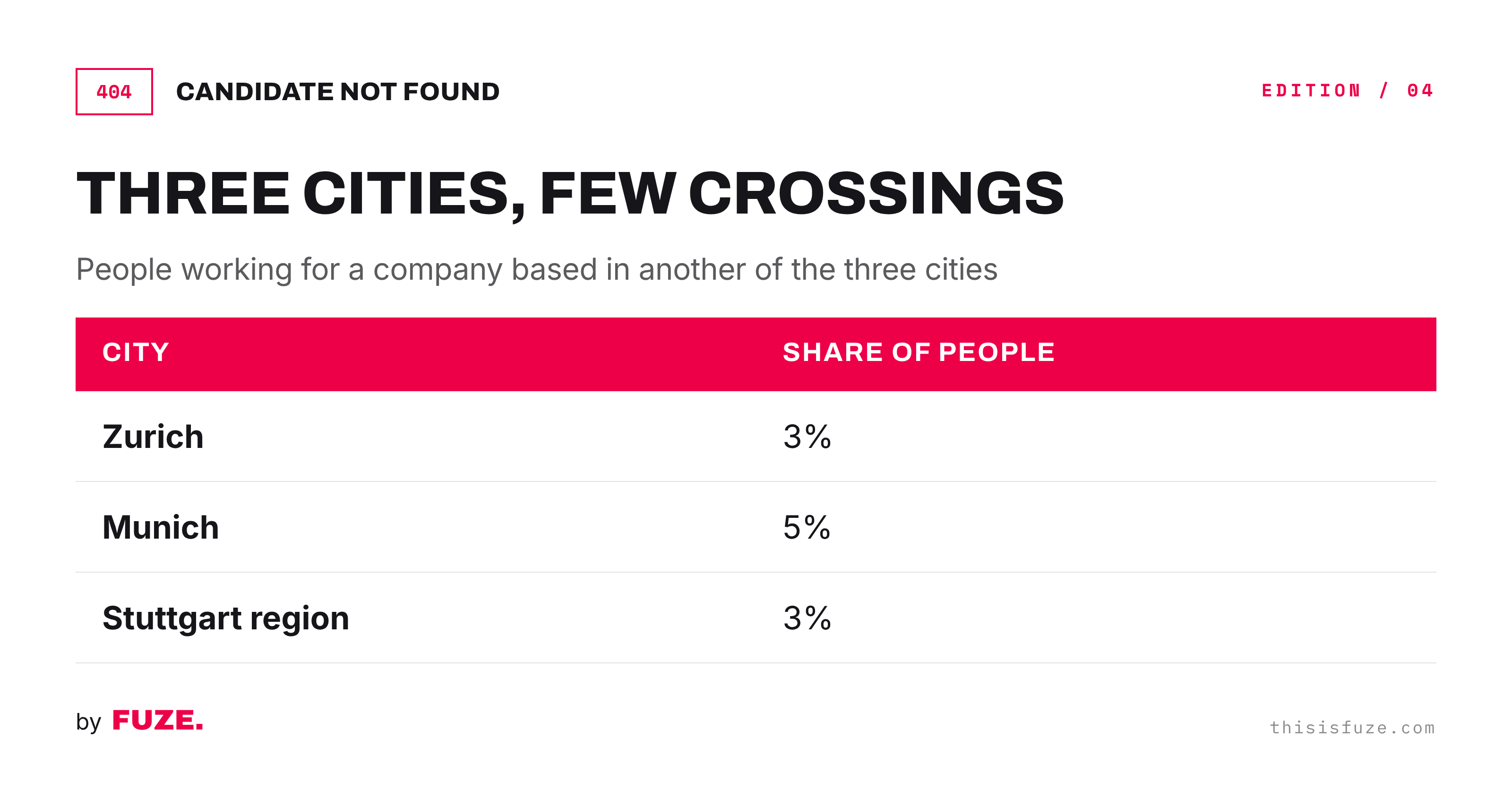
Fewer than 1 in 20 people across the three cities are based in one city while working for a company headquartered in another of the three.
Feels like most teams hire from their own city first. Fair enough, but it means a lot of good people a couple of hours away probably never make the shortlist.
The bigger pull comes from further away. Around 1 in 5 work for a company headquartered outside the three cities, many at US companies with European teams like Intrinsic and Applied Intuition. You probably won't out-pay them line by line, and IMO you don't need to. From what I've seen, local teams often win on being closer to the decisions, more scope earlier and a shorter path from idea to robot. Flexibility is another, and one of the easiest to offer.
If your competitors only search their own city, the best people in the other two have barely been approached.
What this means for your hiring strategy: in each city, only about 3% to 5% of people work for a company based in another of the three.
My read: the shortlist a couple of hours away is probably largely untouched, and I think the teams willing to go and find people in the other two cities will be able to attract and close candidates faster.
What to do: For your two hardest roles, search the three cities from day one, not as a fallback. Decide up front what you can offer someone two to three hours away: hybrid, set travel days, relocation support or a small second hub. Then say it in the job ad and on the first call.
The most settled people are in software, not AI
Once you know where to search, the next question is who's more likely to be open to a chat. About 2 in 5 software people have been in their current role for 2 years or more. For AI and research people it's about 1 in 4, the lowest of any group.
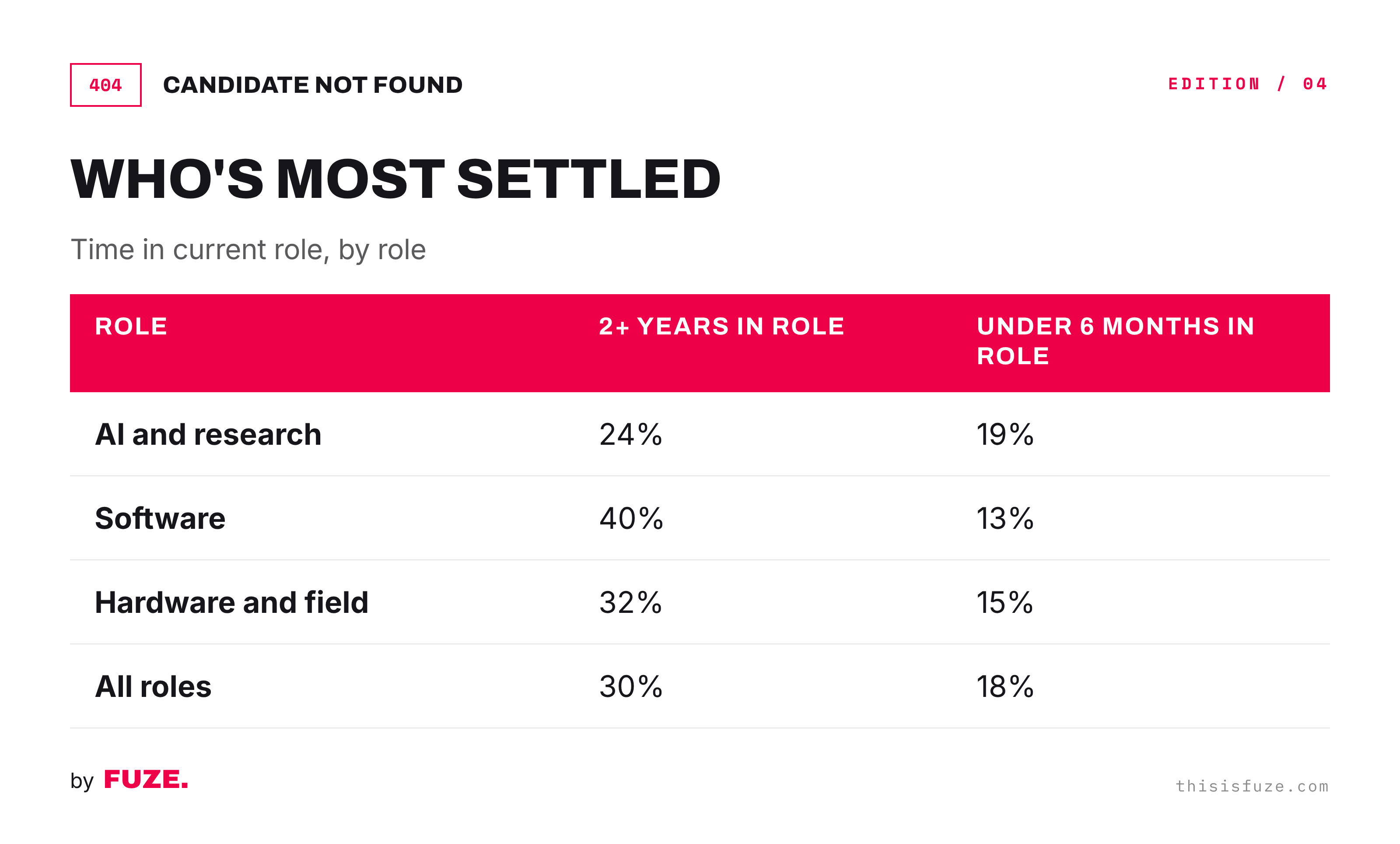
What this means for you: AI and research people are the newest in their seats, and software people the most settled.
My read: I think that fits with how hard teams have been chasing AI people. My sense is a lot of teams pile into the same AI searches, while settled software and hardware people get fewer calls. Time in role on its own is a blunt signal, so I'd layer company signals on top: who has just raised, who is hitting or missing deployment goals, and where senior leadership has changed.
What to do: Build your target list by city, then company signals, then time in role. Being longer in a role doesn't mean someone will move, but in my experience it's often a better time to start the conversation.
Candidate corner
If you're in one of these cities, your next role could be a few hours away on the train.
If you've done sales, sales engineering or customer-facing work in Munich or around Stuttgart, Zurich teams getting ready to sell may need you more than you'd think.
My advice: ask about flexibility early, because a lot of teams have more room there than the job ad suggests.
Open Roles We Are Hiring for at Fuze
Active roles we're working on right now, from startups to scale-ups:
Founding Team
- Application Engineer: Munich
- Solution Engineer: Munich
- Technical Program Manager: Munich
- Robotics Deployment Engineer: Munich
- Fleet Response Engineer: Munich
Other open roles
- Head of Product, Robot Arms: Germany
- Senior Product Manager, Humanoids and Cobots: Germany
- Software Project Manager, Robotics: Germany
- Software Lead, Robotics: Germany
- Deep Learning Team Lead, Perception: San Jose
- Senior Deep Learning Engineer, Perception: San Jose
Hiring for something similar, or open to a move? Drop me a DM and we'll find a time to chat.
www.thisisfuze.com